Community Stories
Community Stories
Community Stories
More Than a Snack: Street Vending, Survival, and Food Deserts in California
More Than a Snack: Street Vending, Survival, and Food Deserts in California
More Than a Snack: Street Vending, Survival, and Food Deserts in California
Amia Carillo Ramanthan
Amia Carillo Ramanthan
February 10, 2026
February 10, 2026
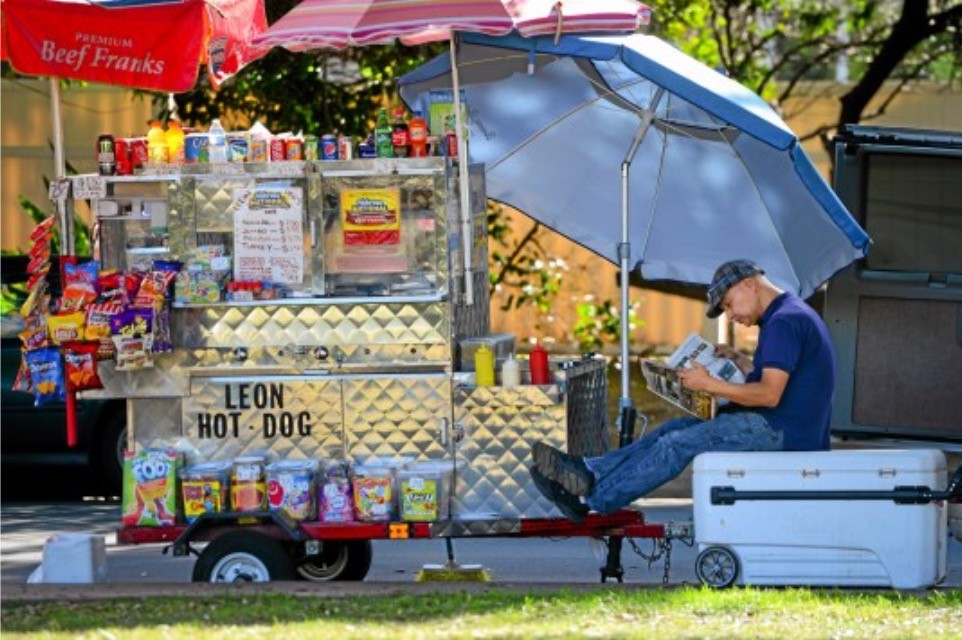
We’ve all seen them: bright-colored umbrellas, shaded carts stacked with chamoy-covered fruit, esquites drenched in cotija, chile and lime, and massive bags of fried chicharrones hanging from the top. These snack carts lovingly adorn California corners, serving lines packed with children after school, tired commuters in need of refreshment and passing dog walkers. They scratch the itch of snack lovers and provide the much-needed sustenance that California communities know and love. But these carts are more than what they serve: they are a means of survival, not just for the vendors who run them, but for the neighborhoods that rely on them in cities shaped by inequality and food deserts.
As stated by Carolina Martinez in her 2022 article for CalMatters, each year in Los Angeles about 12,500 street vendors drum up millions of dollars of revenue. Of the 50,000 vendors scattered throughout LA, about 80% of them are women, with the majority of the group being immigrants, people of color, seniors, and low-income community members. These numbers reveal that street vending is not the hobby or side hustle it is often painted as in the media: it is a labor market for people systematically excluded from stable, higher-paying work. The reality is, while these carts are often painted in a negative light, being described as dirty or promoting unhealthy eating habits, in reality they boost the economy and uplift the immigrant community. However, I would argue that more than symbols of entrepreneurship within the Latinx community, snack carts address a need created by the existence of food deserts.
A food desert occurs when neighborhoods lack access to fresh produce and affordable grocery stores causing increased rates of diabetes, cardiovascular disease, obesity and reduced life expectancy. According to the U.S. Department of Agriculture, in urban areas a neighborhood is deemed a food desert if a food market is more than a mile away, while rural areas neighborhoods are considered deserts if a market is more than 10 miles away. The existence of food deserts disproportionately affects communities of color as a result of systemic racism, economic inequality, and historical disinvestment in people of color.
It is no surprise that neighborhoods considered redlined districts, areas of cities where communities of color were systematically forced to reside, overlap with the areas where food deserts are more prevalent. Neighborhoods in LA such as Boyle Heights were notoriously categorized as undesirable Grade D, or red districts by the Home Owners Loan Corporation(HOLC) while simultaneously being known as a food desert, or food swamp region. In neighborhoods like these, street vendors often become the most consistent source of fresh fruit, prepared food and affordable snacks within walking distance. They are the informal infrastructure that addresses a need created by this racialized and systematic issue.
The rhetoric around addressing food deserts, particularly the health ramifications of lacking access to fresh produce and nourishment, often centers on encouraging people to “eat healthier.” While this statement alone is not problematic, this framing places responsibility on individuals rather than on the structural conditions that shape what food is accessible. Campaigns that focus on simply cutting out “unhealthy” foods or limiting street vending assume that better choices are matters of willpower, ignoring the realities, cost, distance, time, and culture in communities with limited resources.
While addressing the consequences of food insecurity is of utmost importance, the way that solutions are proposed and implemented matters. Policies and public discourse that frame snack carts as a part of the problem risk collapsing an entire informal food economy that supports immigrant families, seniors, women of color, and low-income workers. Thus, efforts to “clean up” or eliminate street vending in the name of preserving public health often do more harm than
good. They threaten jobs, weaken community networks, and remove culturally familiar food spaces while failing to address the deeper roots of food deserts.
Meaningful solutions to these problems would be grounded in racial and cultural understanding. Food is not just nourishment, it is memory, connection, and identity. Snack carts create spaces togather, where languages and traditions are shared and cultural food remains visible. To treat these spaces as disposable or inherently harmful grossly ignores their social, cultural, and economic importance and contribution.
Instead of advocating for the regulation or removal of these carts, we should be questioning why so many communities rely on them. These beautiful, bright-colored snack carts are not a symptom of the issue, they are proof of the resilience and ingenuity that is born in the face of adversity and resource constraint. Snack carts are a celebration of survival.
References
https://www.ers.usda.gov/data-products/food-access-research-atlas/documentation
https://food-deserts.com/food-deserts-in-los-angeles/
https://www.laalmanac.com/history/hi727.php
https://www.astho.org/communications/blog/2025/state-policies-aim-to-eliminate-food-deserts/
https://www.medicalnewstoday.com/articles/what-are-food-deserts
We’ve all seen them: bright-colored umbrellas, shaded carts stacked with chamoy-covered fruit, esquites drenched in cotija, chile and lime, and massive bags of fried chicharrones hanging from the top. These snack carts lovingly adorn California corners, serving lines packed with children after school, tired commuters in need of refreshment and passing dog walkers. They scratch the itch of snack lovers and provide the much-needed sustenance that California communities know and love. But these carts are more than what they serve: they are a means of survival, not just for the vendors who run them, but for the neighborhoods that rely on them in cities shaped by inequality and food deserts.
As stated by Carolina Martinez in her 2022 article for CalMatters, each year in Los Angeles about 12,500 street vendors drum up millions of dollars of revenue. Of the 50,000 vendors scattered throughout LA, about 80% of them are women, with the majority of the group being immigrants, people of color, seniors, and low-income community members. These numbers reveal that street vending is not the hobby or side hustle it is often painted as in the media: it is a labor market for people systematically excluded from stable, higher-paying work. The reality is, while these carts are often painted in a negative light, being described as dirty or promoting unhealthy eating habits, in reality they boost the economy and uplift the immigrant community. However, I would argue that more than symbols of entrepreneurship within the Latinx community, snack carts address a need created by the existence of food deserts.
A food desert occurs when neighborhoods lack access to fresh produce and affordable grocery stores causing increased rates of diabetes, cardiovascular disease, obesity and reduced life expectancy. According to the U.S. Department of Agriculture, in urban areas a neighborhood is deemed a food desert if a food market is more than a mile away, while rural areas neighborhoods are considered deserts if a market is more than 10 miles away. The existence of food deserts disproportionately affects communities of color as a result of systemic racism, economic inequality, and historical disinvestment in people of color.
It is no surprise that neighborhoods considered redlined districts, areas of cities where communities of color were systematically forced to reside, overlap with the areas where food deserts are more prevalent. Neighborhoods in LA such as Boyle Heights were notoriously categorized as undesirable Grade D, or red districts by the Home Owners Loan Corporation(HOLC) while simultaneously being known as a food desert, or food swamp region. In neighborhoods like these, street vendors often become the most consistent source of fresh fruit, prepared food and affordable snacks within walking distance. They are the informal infrastructure that addresses a need created by this racialized and systematic issue.
The rhetoric around addressing food deserts, particularly the health ramifications of lacking access to fresh produce and nourishment, often centers on encouraging people to “eat healthier.” While this statement alone is not problematic, this framing places responsibility on individuals rather than on the structural conditions that shape what food is accessible. Campaigns that focus on simply cutting out “unhealthy” foods or limiting street vending assume that better choices are matters of willpower, ignoring the realities, cost, distance, time, and culture in communities with limited resources.
While addressing the consequences of food insecurity is of utmost importance, the way that solutions are proposed and implemented matters. Policies and public discourse that frame snack carts as a part of the problem risk collapsing an entire informal food economy that supports immigrant families, seniors, women of color, and low-income workers. Thus, efforts to “clean up” or eliminate street vending in the name of preserving public health often do more harm than
good. They threaten jobs, weaken community networks, and remove culturally familiar food spaces while failing to address the deeper roots of food deserts.
Meaningful solutions to these problems would be grounded in racial and cultural understanding. Food is not just nourishment, it is memory, connection, and identity. Snack carts create spaces togather, where languages and traditions are shared and cultural food remains visible. To treat these spaces as disposable or inherently harmful grossly ignores their social, cultural, and economic importance and contribution.
Instead of advocating for the regulation or removal of these carts, we should be questioning why so many communities rely on them. These beautiful, bright-colored snack carts are not a symptom of the issue, they are proof of the resilience and ingenuity that is born in the face of adversity and resource constraint. Snack carts are a celebration of survival.
References
https://www.ers.usda.gov/data-products/food-access-research-atlas/documentation
https://food-deserts.com/food-deserts-in-los-angeles/
https://www.laalmanac.com/history/hi727.php
https://www.astho.org/communications/blog/2025/state-policies-aim-to-eliminate-food-deserts/
https://www.medicalnewstoday.com/articles/what-are-food-deserts

Project Lux
Street-level support. System-level change.
© 2025
Project Lux is a 501(c)(3) nonprofit organization.
EIN: 86-1951744
Project Lux
Street-level support. System-level change.
© 2025
Project Lux is a 501(c)(3) nonprofit organization.
EIN: 86-1951744